See what your palette can mix before you mix it.
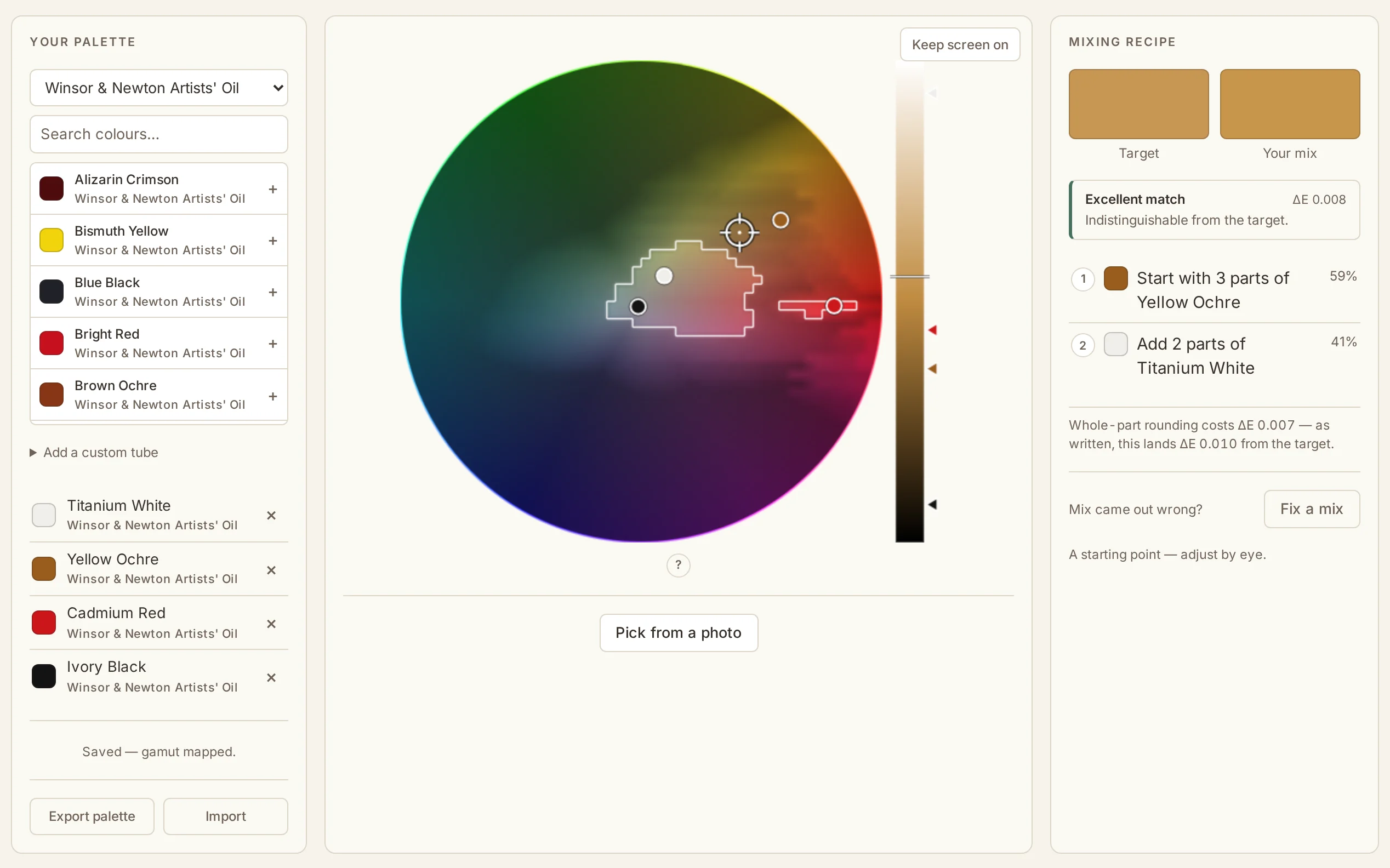
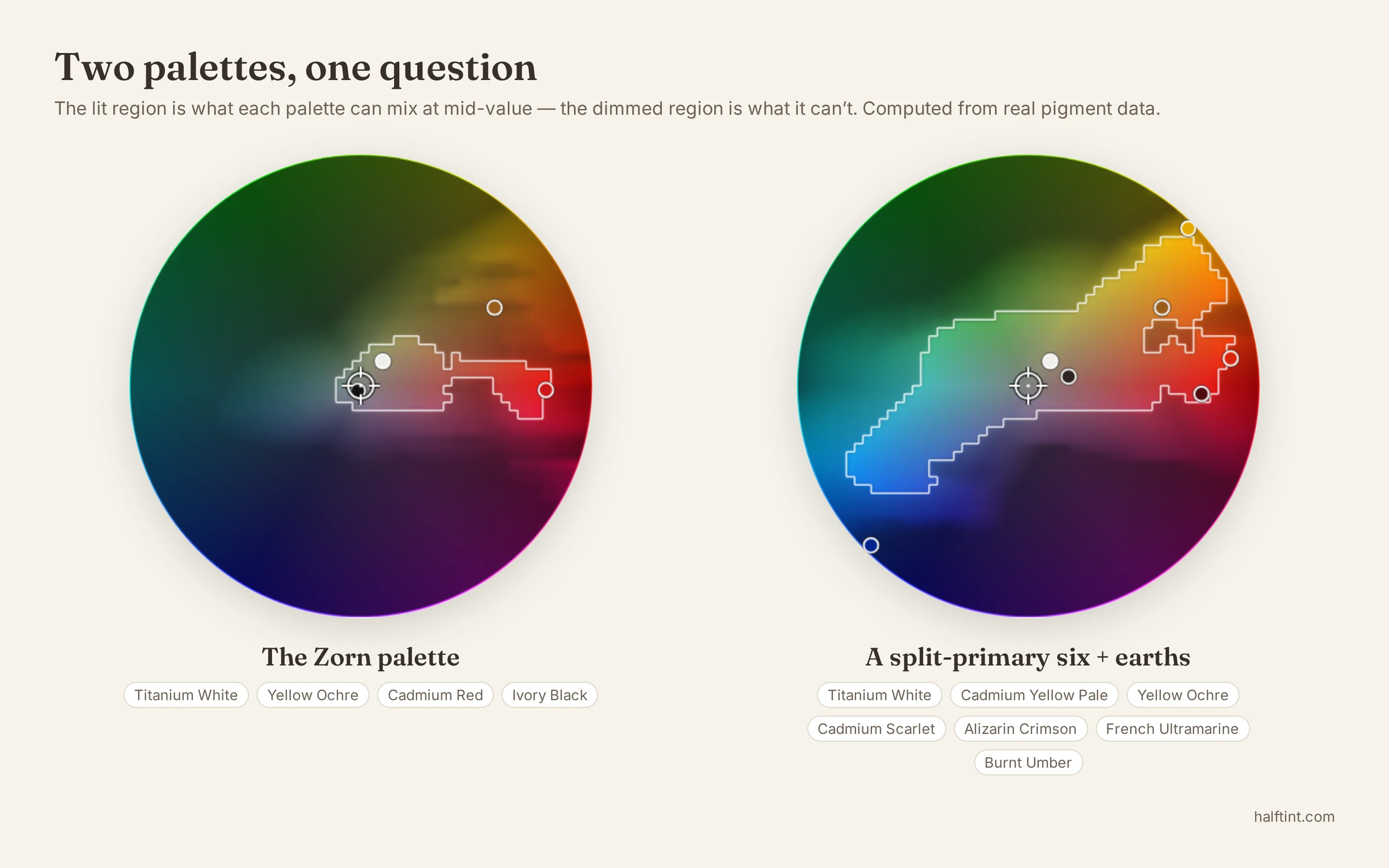
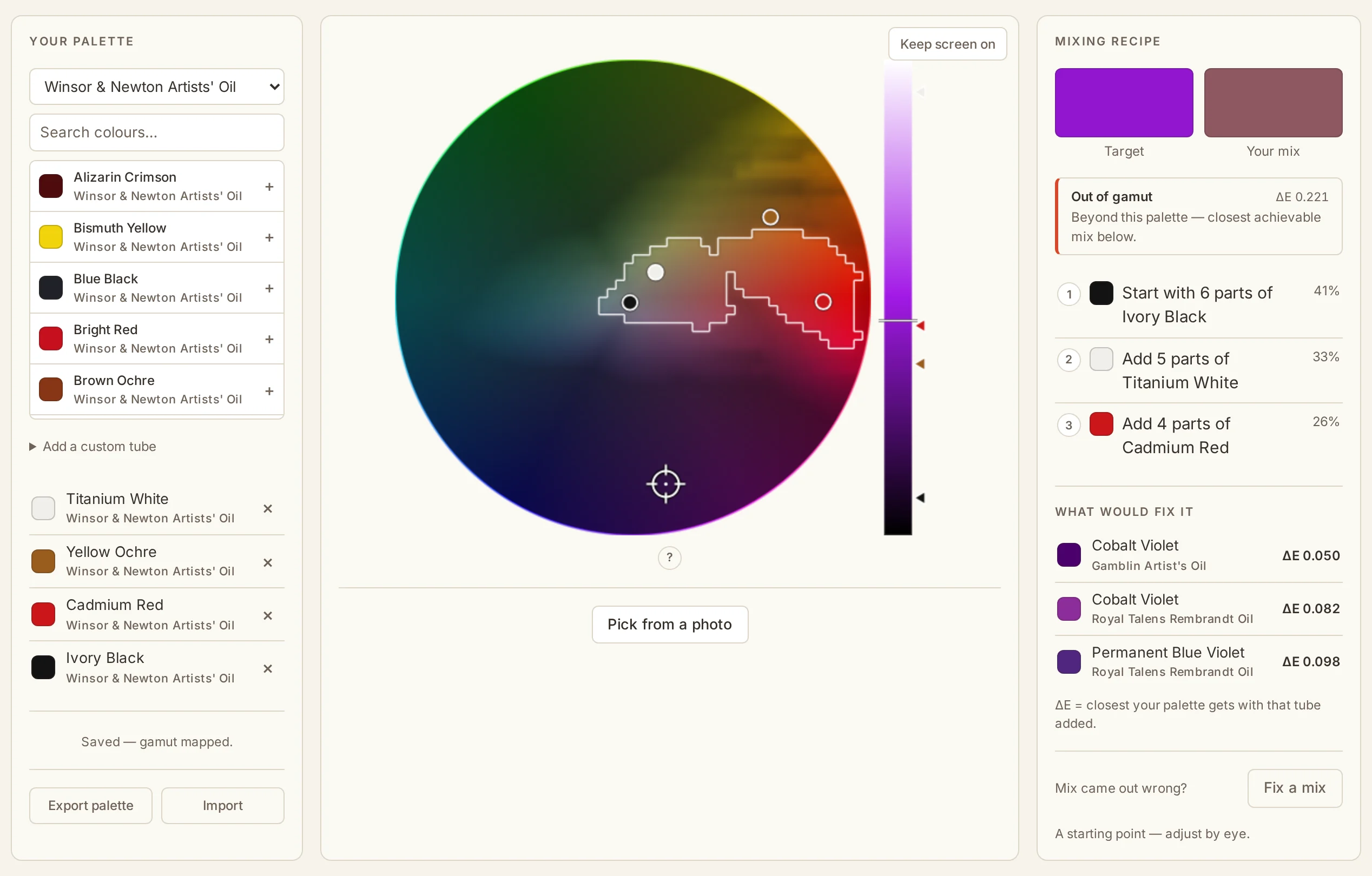
Halftint is a free colour-mixing tool for oil painters. Add the tubes you own and it draws the range of colours they can reach on the wheel. Pick a colour inside that range and it gives you a recipe in knife-parts, with mixing order and a predicted ΔE. Pick one outside it and it tells you, shows the closest mix, and names a tube that would get you there.
Why I built it
I kept mixing mud.
I started painting in oils fairly recently. Like most beginners I spent a lot of time and paint chasing colours my palette could not make, and I couldn’t tell whether the problem was my mixing or my tubes. The books draw a generic colour wheel. Nobody draws the wheel for the six tubes you happen to own.
So I wrote a program to do it. It uses the standard physics of pigment mixing (Kubelka–Munk, the same theory the paint industry uses) to work out what a given set of tubes can reach, and it turned out to answer my question every time: this green goes olive because these tubes can’t make it cleaner, and that violet stays grey because the palette has no blue that leans red. I am sharing it because it helped me, and because I would like to know where it is wrong.
Recipes
Knife-parts, in mixing order.
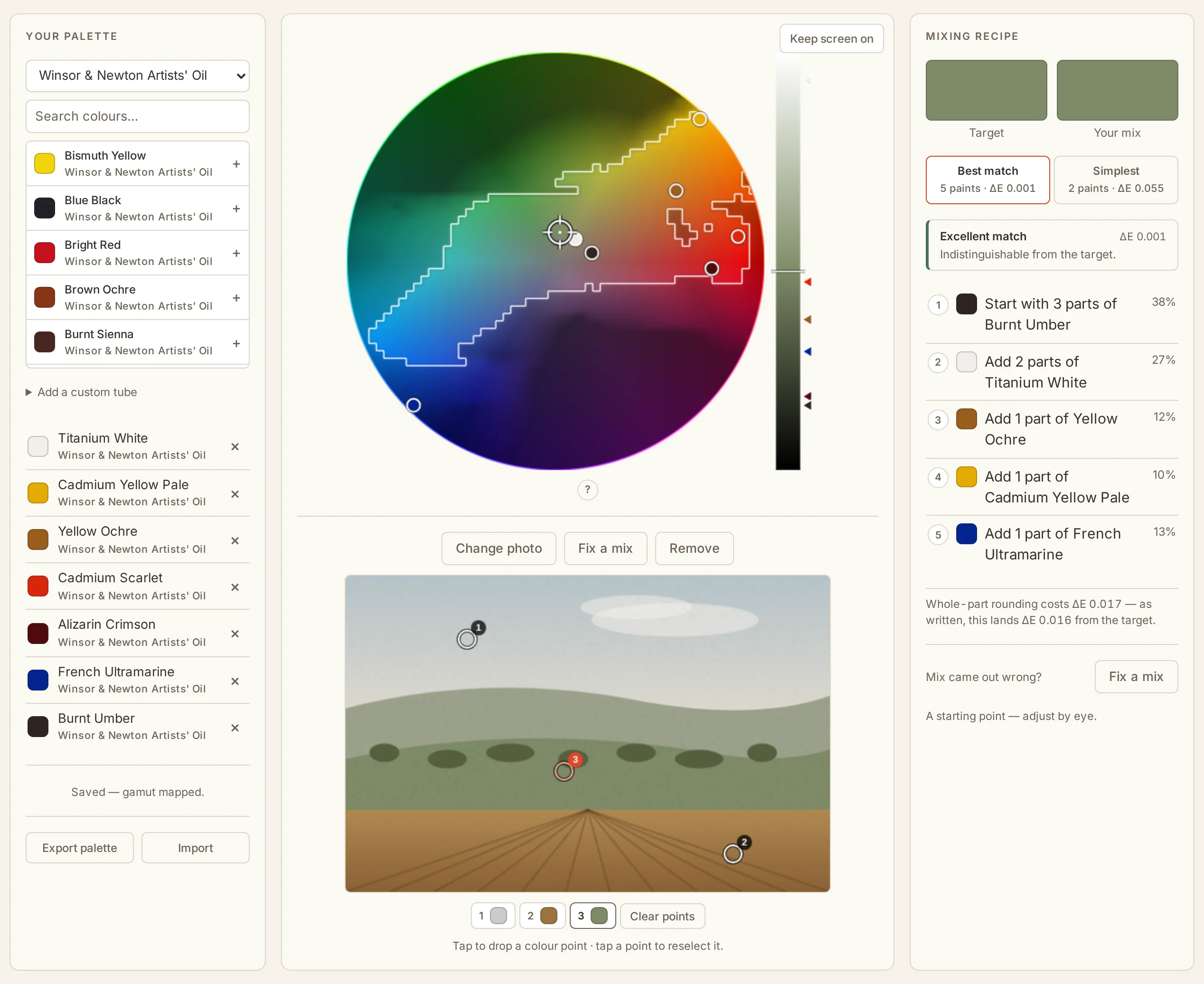
A recipe that says “37.2% PB29” is no use with a palette knife in your hand. Halftint rounds to whole parts (3 parts white, 1 part yellow ochre, a knife-tip of ultramarine) and shows what that rounding costs in ΔE, so you can decide whether it matters for the passage you are painting.
It also gives the order. Some pigments take over a mix: a pile of phthalo will swallow a mound of white and barely change. Halftint knows each paint’s tinting strength, so it puts the strong pigment last and says to add it a speck at a time. It is the sort of thing a teacher tells you once, applied to every recipe.
Mix Fix
When a pile goes wrong.
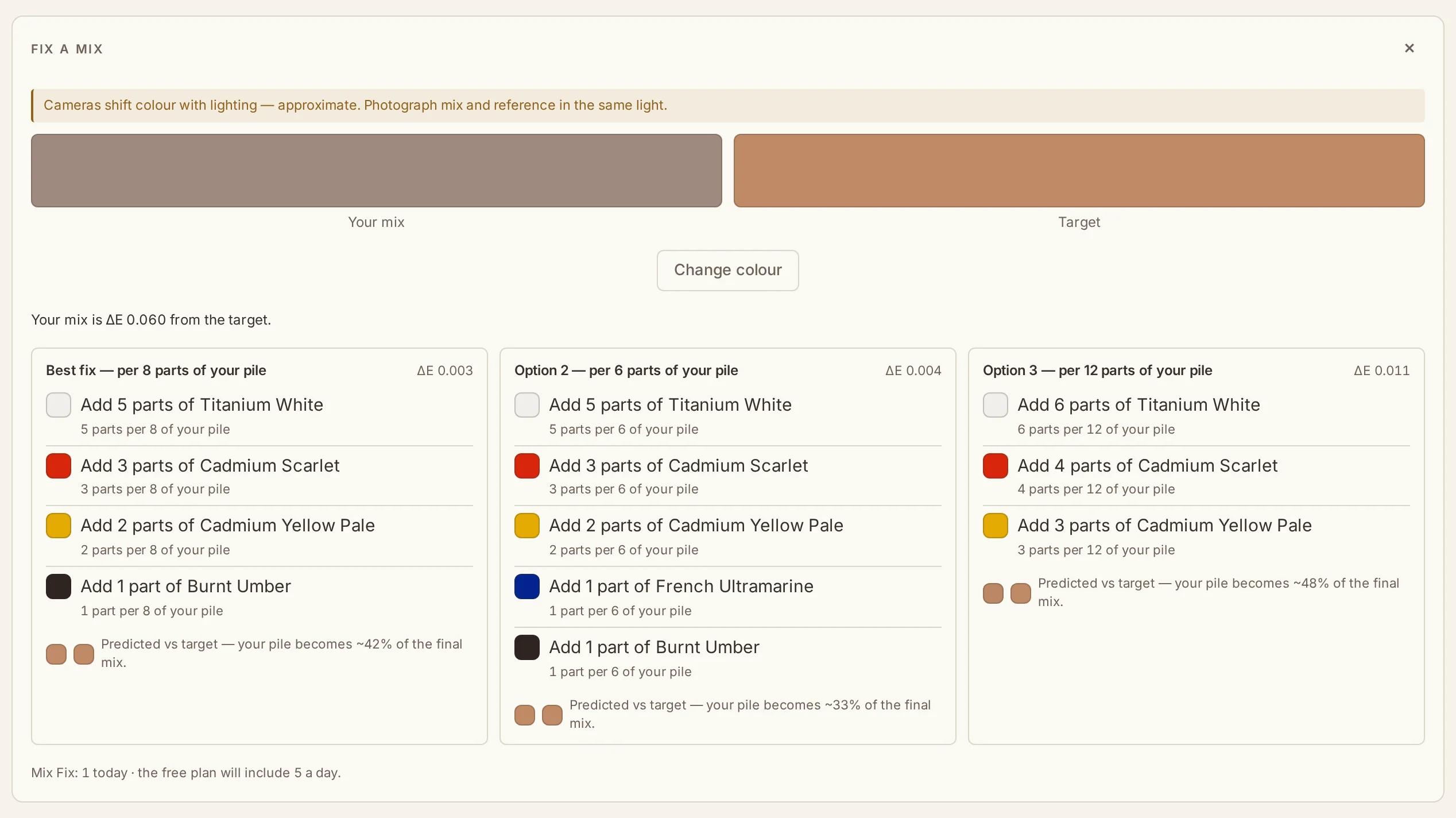
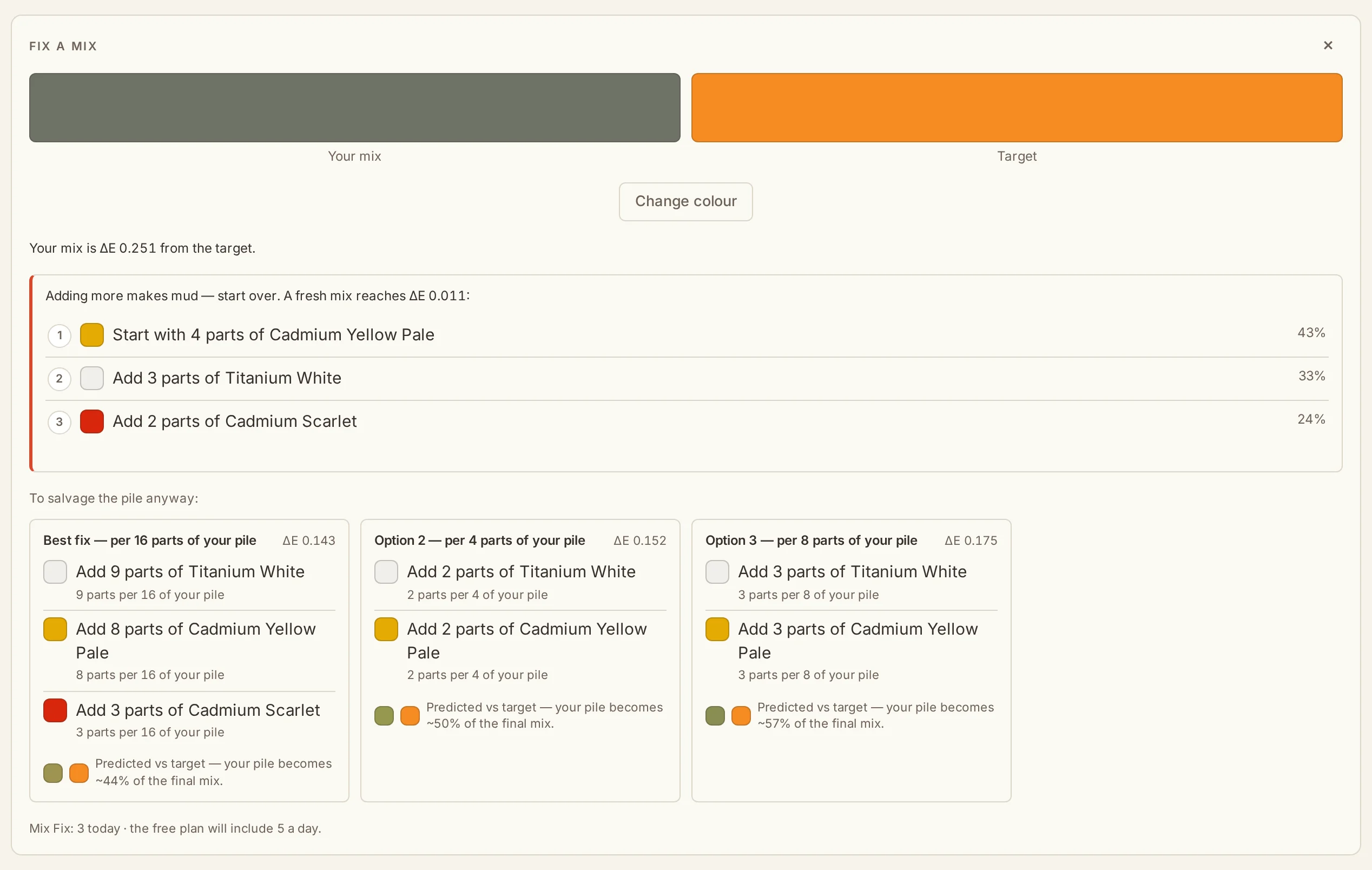
The pile in front of you is too warm and half a tube is already in it. The usual answer is to guess, overcorrect, and end up with more mud. Mix Fix starts from the pile you have: pick its colour from a photo or from the wheel, set the target, and it works out what to add, which tube and roughly how much. When no addition will get there, it says so, and offers a fresh recipe instead.
Photo picking is a comparison tool, not a colour meter. Put the wet pile and the target in the same frame under the same light. See “Is photographing paint with a phone reliable?” below.
Limits
What it doesn’t know
The engine is deterministic physics and I can explain every step of it, but the inputs are imperfect and I would rather say so up front.
- Every recipe shows its ΔE, the predicted distance between the mix and your target. I show the number rather than calling anything a perfect match.
- Out of gamut is stated as such. If your tubes can’t reach a colour, you get the closest reachable mix, the size of the gap, and one tube that would close it.
- Chart colours are labelled approximate. The paint data comes from manufacturers’ published charts, not from measured paint films. I plan to measure real drawdowns with a spectrophotometer and replace the labels as I go.
The aim is not a machine that mixes for you. It is to get most of the way in one mix rather than six, with the final adjustment still made by eye.
How to use it
Add your tubes.
Pick them from the brand lists, or enter any tube by the pigment codes on its label. Save the palette and the wheel is mapped for it.
Pick a target.
Tap the wheel, or pick a colour from a reference photo. The mapped range is drawn under the crosshair, so you can see whether the colour is reachable before you start.
Mix.
Follow the recipe in knife-parts and mixing order, then adjust by eye. If a pile goes wrong, Mix Fix tells you what to add.
Feedback
Tell me where it’s wrong
This is a personal project and I am still learning to paint. If a recipe was off, a tube is missing, the gamut disagrees with your experience, or something is confusing, I want to hear about it. Email me at josiah@comkeyconsulting.com.au. A photo of the mix and the target is the most useful thing you can send.
Questions
How accurate is it?
Good, not perfect. The engine implements Kubelka–Munk mixing following the Sochorová and Jamriška (2021) method, and every recipe shows its predicted ΔE, so you can see how close the maths expects to land. In my own use it gets me most of the way in one mix; the last adjustment is still made by eye at the palette. I would be wary of any tool that promised more than that.
Colours on my screen don’t match real paint. Doesn’t that break it?
Less than you might think. The gamut boundary, the proportions, the mixing order and the ΔE are all computed from pigment data, not from what your display shows. The screen is a preview. If it runs warm, every swatch shifts warm together, and the relationships you mix by survive. For critical matching, trust the recipe and the ΔE over the on-screen swatch.
My brand isn’t listed. Can I still use it?
Yes. Enter the pigment indices from the label (the PW6, PB29, PY42 codes most tubes carry) and Halftint builds a working model of the paint. A custom tube mixes and maps the same way as one from the database.
Does it work offline, at the easel?
Yes. Halftint is an installable web app. Add it to your home screen and the engine runs on your device with no connection needed. It also keeps your screen awake, so the recipe stays put under a painty thumb. Your palette lives on your device, and you can export it to a file to move it between devices.
Does it do acrylics or watercolour?
Oils only for now, because that is what I paint with and what the data covers. Acrylics may follow with their own data; the same pigment behaves differently in a different binder, so I don’t want to relabel the oil data and call it done. Watercolour I have left out. Dilution and paper make recipe prediction unreliable with this method.
What is Kubelka–Munk, in plain terms?
The physics of why paint doesn’t mix like light. Pigment particles absorb some wavelengths and scatter others, and mixing paint mixes those behaviours rather than the colours themselves. Kubelka and Munk described this mathematically in 1931, and the paint and coatings industries have used it to predict mixtures ever since. Halftint implements it following a 2021 computer-graphics paper. The method page has the full account, including what it can’t do.
Will this stop me learning to mix?
I don’t think so, and I am a beginner myself. The gamut view is the mixing theory a teacher draws on a whiteboard, computed for your own tubes. Recipes show their reasoning: which pigment is doing what, why the order matters, why a target is out of reach. You still do every mix yourself, with a knife.
What happens to my palette data?
It stays on your device. There are no accounts and no ads, and I never see your palette or your colours. I do use Google Analytics to count page views and a few app events (a palette was saved, a recipe was computed) so I can tell whether the tool is being used; the privacy page lists exactly what. You can export your palette to a file at any time.
Is photographing paint with a phone reliable?
Not for absolute colour. Wet paint is glossy and phone cameras process colour aggressively, so no app can read your palette exactly from a photo. What a phone is good at is comparison within one frame: your wet pile next to your target, same light, same shot. That is how Mix Fix uses it, and every capture carries a note about the uncertainty and the white balance.
Try it with your own tubes
Free, no sign-up, nothing to install unless you want it on your home screen.
Open Halftint